PRODUCT DESCRIPTION
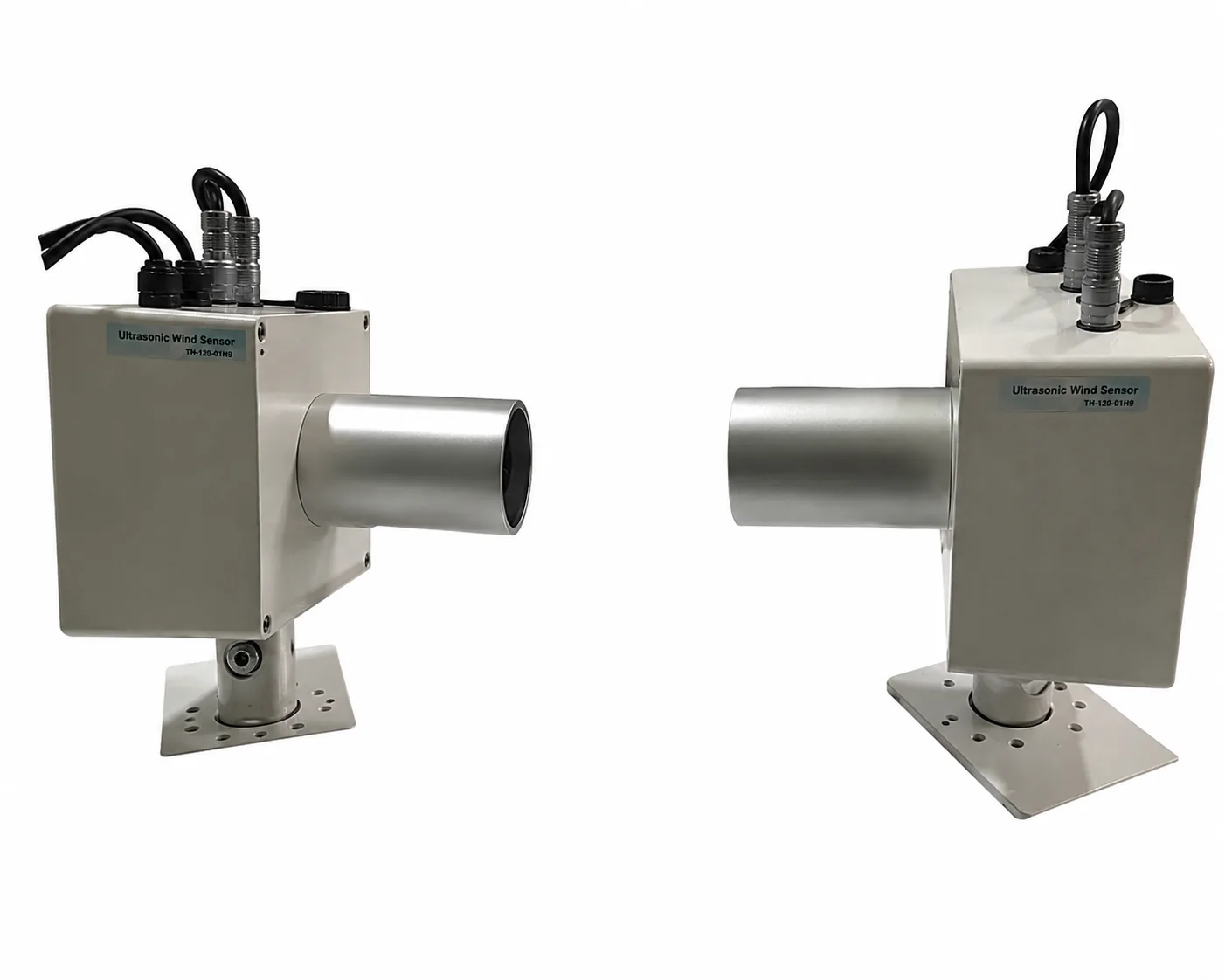
The TH-120-01H9 is an ultrasonic wind speed sensor designed for outdoor wind monitoring and meteorological data collection. Based on its appearance, this model features a rectangular protective enclosure, a horizontal cylindrical sensing channel on the side, cable interfaces and connectors on the top, and a metal mounting bracket with a fixed base plate at the bottom for convenient field installation, wiring, and system integration. It measures wind speed bidirectionally from -30 to +30 m/s with ±0.1 m/s accuracy.
With a robust enclosure-based structure, the product is suitable for installation in weather stations, environmental monitoring stations, industrial field monitoring equipment, and outdoor automation platforms. Rated IP65 and operating from -40 to +70°C and up to 90% RH, it offers RS232 and RS485 digital interfaces, a 4–20 mA analog output (load < 500 Ω), and two dry-contact relay outputs. The TH-120-01H9 can work with data loggers, controllers, or integrated weather monitoring systems to collect on-site wind condition data and provide data support for meteorological analysis, environmental management, equipment linkage, and automation control.
SPECIFICATIONS
| Sensor Type | Ultrasonic anemometer (wind speed) |
| Wind Speed Range | -30 to +30 m/s (bidirectional) |
| Wind Speed Accuracy | ±0.1 m/s |
| Digital Interface | RS232, RS485 |
| Analog Output | 4–20 mA (load < 500 Ω) |
| Relay Output | 2-way dry-contact relay output |
| Sample Path | 5–50 m |
| Protection Rating | IP65 |
| Operating Temperature | -40 to +70°C |
| Operating Humidity | Up to 90% RH |
PRODUCT APPLICATION
The TH-120-01H9 ultrasonic wind speed sensor is widely used in weather stations, environmental monitoring stations, smart agriculture systems, photovoltaic power stations, wind energy projects, roads, bridges, ports, docks, industrial field monitoring, outdoor safety monitoring, and automation control systems.
It is suitable for outdoor monitoring systems that require wind speed data collection, especially for projects that need an enclosure-based structure, stable mounting bracket, and centralized wiring design. It helps users understand real-time on-site wind environment changes and provides reference data for equipment operation, safety warning, and environmental data analysis.